
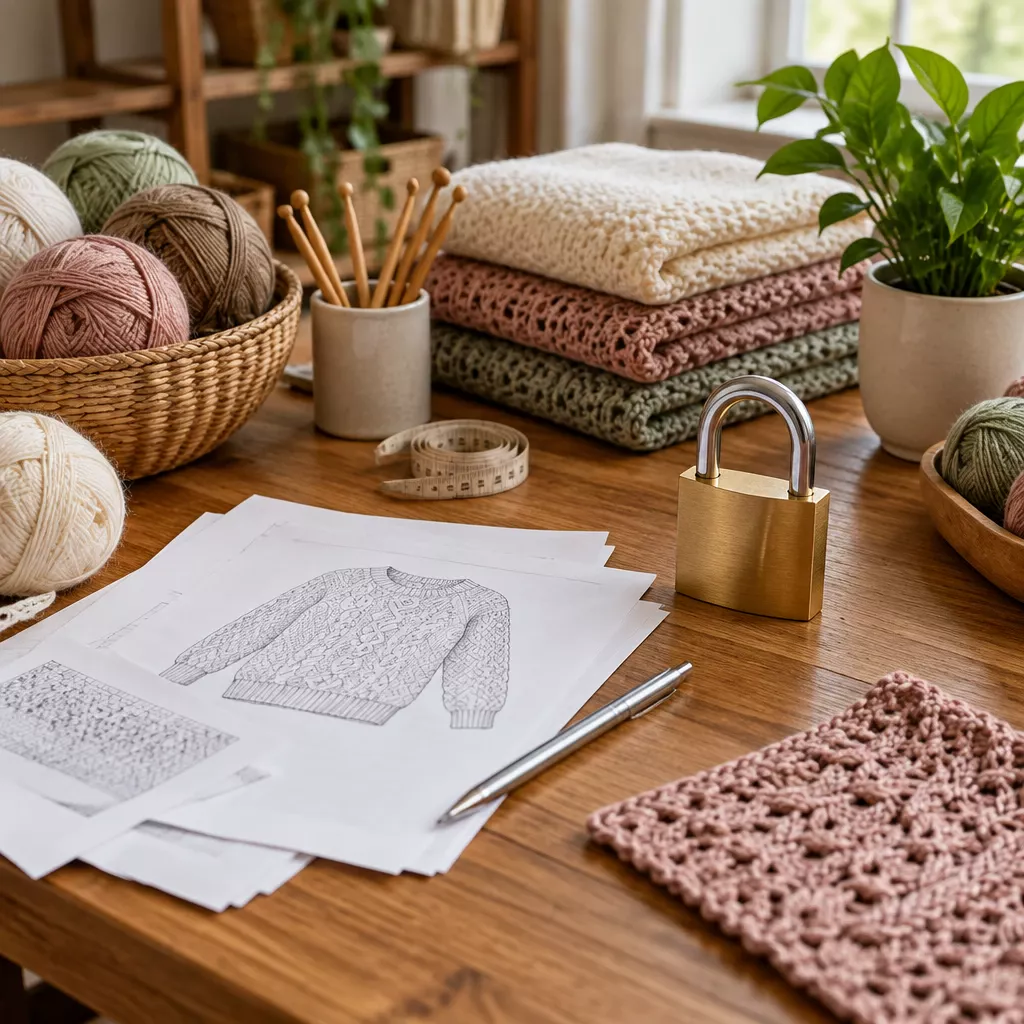
Copyright protection for craft patterns begins with understanding what copyright actually protects—and what it does not. A pattern’s written instructions, original illustrations, photographs, charts, and distinctive arrangement may qualify as copyrightable expression. However, the underlying idea, basic technique, stitch, shape, or method of making an item may remain free for others to use. That distinction matters when a designer discovers that a pattern has been copied, reposted, translated, or sold without permission.
The practical challenge is often not proving that copyright exists. Copyright generally arises automatically when an original work is fixed in a tangible form. The harder questions are: When did you create the pattern? Which files represent your original work? Can you show that your version existed before the allegedly copied version? This guide explains how to document originality, preserve evidence, respond to copying, and use dated notarized records as a complement to—not a replacement for—registration with the U.S. Copyright Office.
Copyright Protection for Craft Patterns: What Is Actually Protected?
Copyright protects original expression that is recorded in a tangible medium. For craft designers, that can include a written pattern, original diagrams, instructional text, photographs, video lessons, and creative graphic elements. A knitting, crochet, sewing, quilting, jewelry, or paper-craft pattern may contain several separate works, each with its own copyright considerations.
For example, a designer may own copyright in the specific wording used to explain a technique, the original illustrations showing each step, and the selection and arrangement of instructional content. A finished item made by following the pattern is not necessarily protected in the same way. In addition, copyright does not generally protect an idea, procedure, process, system, or method of operation. A basic granny-square concept, a common bead arrangement, or a standard way to construct a sleeve may be difficult to claim as exclusive copyright expression.
Expression versus technique
The most useful question is not, “Did I invent this type of craft?” Instead, ask, “What original expression did I create?” That expression could include an unusually detailed explanation, a distinctive diagram system, a creative sequence of photographs, or a highly original combination of instructions and design elements.
Short phrases, common abbreviations, familiar symbols, and purely functional directions may receive limited protection. Nevertheless, a pattern can still contain protectable material even when individual instructions are ordinary. Copyright may protect the original selection, coordination, and arrangement of those elements, provided the work contains at least a modest amount of creativity.
Patterns, finished goods, and listings
Keep separate records for the pattern and the physical item made from it. A finished craft may contain artistic features, but the legal analysis can differ depending on whether those features are separable from functional aspects. Product photographs, website descriptions, packaging artwork, and social media graphics may also be independently protectable works.
This same framework applies beyond indoor crafts. Mural copyright protection, street art ownership, and public art copyright often depend on identifying the artist’s original visual expression, rather than claiming ownership over a general subject, style, or public concept. Whether the work is a quilt pattern or a wall painting, good documentation makes the originality claim easier to explain.
How to Build Evidence That Your Pattern Is Original
Strong evidence is created during the design process, not hurriedly assembled after a dispute begins. A creator should maintain a practical record showing how an idea developed into a finished pattern. No single file guarantees success, but multiple consistent records can establish a persuasive timeline.
Create a dated design trail
Save early sketches, handwritten notes, test versions, sample photographs, measurement charts, and draft instructions. Preserve the files in their original formats when possible, rather than saving only a final PDF. File metadata can be helpful, although metadata may be changed and should not be treated as conclusive by itself.
Useful evidence may include:
- Original sketches, diagrams, and design notes;
- Drafts showing revisions to wording, measurements, or construction;
- Photographs of prototypes at different stages;
- Emails or messages discussing the design with a test maker;
- Source files for illustrations, charts, layouts, and photographs;
- Invoices, project records, or marketplace drafts showing when the work was prepared;
- Final pattern files and a written statement identifying the creator.
Use consistent file names and retain backups in more than one location. A simple naming system such as “Winter-Scarf-Pattern-Draft-01” and “Winter-Scarf-Pattern-Final” can make the creative sequence much easier to follow. Avoid overwriting earlier drafts, because the history of changes may help show independent development.
Document authorship before publication
Before releasing a pattern publicly, consider assembling the relevant materials into a clearly identified evidence package. The package might contain the final pattern, selected drafts, supporting images, and a declaration explaining when and how the work was created. Keep a copy of exactly what was submitted and record the date.
Copyrightrecords.com provides a $17 copyright certificate paired with notarization for this type of documentation. The certificate records the creator’s claim and the work at a particular time, while notarization supplies an independent third-party confirmation of the signing or acknowledgment. This creates dated, witnessed evidence of authorship that may be useful if the timeline is later disputed.
That record is evidentiary protection, not official registration. It does not make a pattern “government registered,” and it does not replace registration with the U.S. Copyright Office. Its purpose is to help preserve proof of what you claimed and when you claimed it.
What to Do When Someone Copies or Resells Your Pattern
Discovering a copied pattern can be upsetting, especially when the other party is selling it or presenting it as original. Before contacting the alleged infringer, preserve evidence carefully. Take screenshots showing the URL, seller name, product title, price, images, and date. Download or save pages where lawful, and note whether the listing later changes.
Compare the works systematically. Identify matching wording, unusual errors, identical diagrams, the same sequence of photographs, or distinctive formatting. Similar subject matter alone may not prove copying. Common craft techniques and standard construction language can appear in multiple independently created patterns. The strongest comparisons focus on original expression and details that are unlikely to have occurred by coincidence.
Steps to take before sending a complaint
- Preserve your original records. Keep drafts, source files, publication dates, and any certificate or notarized documentation together.
- Capture the alleged copy. Record the complete listing and seller information, not only one image.
- Identify the specific similarities. Separate protectable text, illustrations, photographs, and arrangement from general ideas or techniques.
- Check ownership and agreements. A contractor, collaborator, employer, or client may have rights depending on the written agreement and the circumstances.
- Choose a proportionate response. Options may include a professional licensing request, marketplace complaint, DMCA notice where appropriate, or consultation with a copyright lawyer.
Do not make accusations that go beyond the evidence. A calm, factual notice can preserve credibility and may resolve a problem faster than an angry public post. Also, remember that a platform takedown process is not the same as a court ruling. If the dispute is significant, legal advice can help you assess ownership, fair use, jurisdiction, and available remedies.
Proving mural authorship and related creative work
The same evidence principles help with proving mural authorship and documenting a street artist copyright claim. Preserve sketches, site photographs, contracts, permission letters, time-lapse footage, invoices, and communications with property owners. For public art, identify who commissioned the work, who owns the physical wall or object, and whether any agreement addresses reproduction, removal, licensing, or attribution.
Owning the physical surface does not automatically mean owning copyright in the artwork. Conversely, creating the artwork does not always answer every question about installation, alteration, or commercial use. Written agreements and a clear creation timeline are especially important for murals and commissioned pieces.
Notarized Evidence, Copyright Registration, and Legal Limits
Because copyright is automatic, creators sometimes assume that no additional documentation is needed. In practice, evidence can matter greatly when ownership or timing is challenged. A dated, witnessed record can support a creator’s account by showing that the work and authorship claim existed at a particular point.
Notarization adds an independent third party’s confirmation to the record. It does not independently determine whether the work is original, decide who owns it, or guarantee a court result. Instead, it can make the documentation harder to dismiss as a record created only after a dispute began.
This is different from the outdated “poor man’s copyright” idea of mailing a sealed envelope to yourself. A self-mailed envelope is not a substitute for copyright registration and does not automatically prove the contents or authorship. A professional documentation service using a certificate and actual third-party notarization creates a more structured record, but it remains evidence—not federal registration.
When U.S. Copyright Office registration matters
If you believe someone infringed your U.S. copyright, registration is a separate and important step. Under 17 U.S.C. §411(a), and following Fourth Estate Public Benefit Corp. v. Wall-Street.com, a creator generally must have a completed registration from the U.S. Copyright Office before filing a federal copyright infringement lawsuit. A certificate from Copyrightrecords.com does not change that requirement.
Statutory damages and attorney’s fees are also tied to timely U.S. Copyright Office registration, not to a private certificate or notarization. Registration may be especially important before infringement occurs or within the applicable timing rules. Because deadlines and remedies can depend on the facts, creators should consult a qualified copyright attorney when a dispute has meaningful financial or business consequences.
Conclusion: Make Your Pattern’s Creative History Easy to Prove
Copyright protection for craft patterns is strongest when creators understand the boundary between an unprotected idea or technique and protectable original expression. Preserve drafts, source files, prototypes, photographs, agreements, and publication records. If your work is copied, compare specific expressive details and document the alleged infringement before taking action.
Copyright exists automatically when you create an original work. What can be difficult later is proving when you created it and that it is truly yours. A Copyrightrecords.com certificate with notarization can provide dated, witnessed evidence of authorship at an affordable cost. It works alongside U.S. Copyright Office registration—not instead of it. For creators of craft patterns, murals, street art, and public art, building that evidence early can turn an uncertain authorship claim into a clearer, better-supported record.