

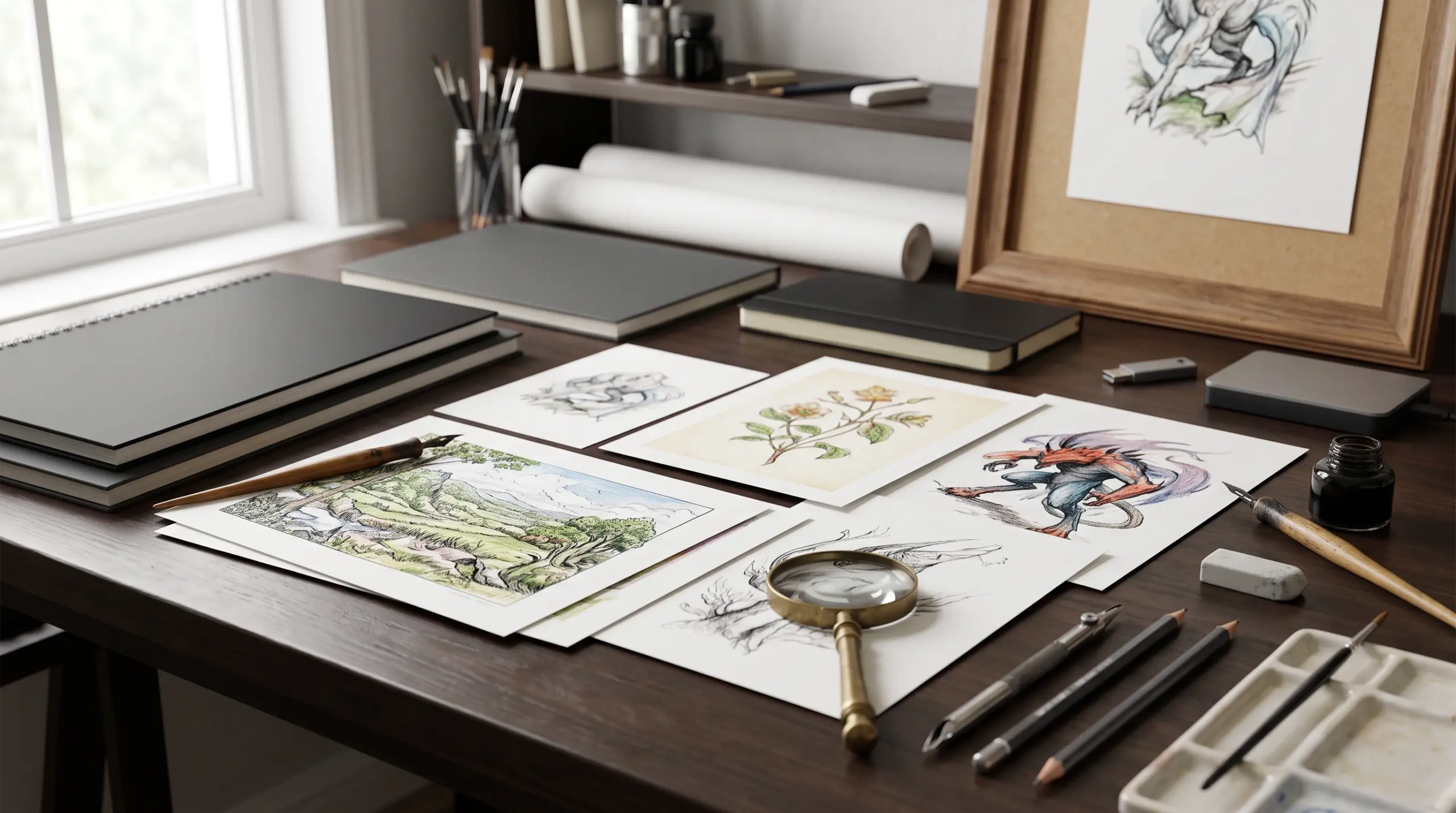
Copyright protection for illustrations begins the moment you create an original drawing, painting, graphic, or digital artwork. However, automatic copyright ownership does not always answer the question that matters most during a dispute: when did you create it, and how can you prove the work is yours? An illustration can be copied, reposted, modified, or used commercially without permission while another person claims they created it first. Strong records can make it easier to establish your authorship and challenge that claim.
This guide explains how copyright applies to illustrations, what evidence can help prove illustration ownership, and how illustrators can document both traditional and digital artwork. You will also learn where a dated, notarized certificate fits into a broader copyright strategy—and why it complements, but never replaces, registration with the U.S. Copyright Office.
Copyright Protection for Illustrations Starts With Original Expression
In the United States, copyright generally exists automatically when you create an original work and fix it in a tangible form. “Fixation” can mean putting pencil or ink on paper, saving a digital illustration to a drive, exporting a finished image, or storing artwork in a cloud account. You do not have to publish the illustration, sell it, or place a copyright symbol on it for copyright to exist.
Copyright protects the original expressive elements of an illustration, such as the particular arrangement of shapes, lines, colors, textures, and other creative choices. It does not protect a basic idea, a general artistic style, a short title, or a common visual concept by itself. For example, the idea of drawing a dragon may not be protectable, but your specific dragon illustration may be.
What illustrators may own
Depending on the circumstances, an illustrator may hold rights in:
- Original sketches, character designs, and finished artwork
- Digital paintings, vector illustrations, and 3D artwork
- Illustrations created for books, packaging, websites, games, or merchandise
- Original visual elements incorporated into a larger project
- Eligible adaptations or revised versions of earlier artwork
Ownership can become more complicated when an illustration is commissioned, created by multiple artists, or produced as an employee. A written contract should explain whether the work is licensed, assigned, or intended as a work made for hire. Without clear documentation, disagreements may arise even when everyone agrees about who physically drew the image.
Automatic ownership is valuable, but ownership and proof are different issues. If a client, competitor, or online account disputes your claim, you may need reliable evidence showing the work existed at a particular time and that you claimed authorship. That is why illustration copyright protection should include both lawful creation practices and organized documentation.
How to Prove Illustration Ownership With Strong Evidence
To prove illustration ownership, think in terms of a timeline. The more clearly your records show the development and completion of a work, the easier it may be to explain your authorship. No single file guarantees a successful legal result, and the weight of evidence depends on the facts and the decision-maker. Nevertheless, consistent records are far more useful than relying on memory.
Useful records for traditional artwork
For physical illustrations, keep the original sketchbook, preliminary drawings, color studies, reference notes, and final artwork in a secure location. Scan or photograph important pages, preserving the original files and their creation dates. You can also keep invoices, project briefs, emails, contracts, and delivery records that connect you to the work.
Photographs of an artwork in progress may help establish a sequence of creation. For example, a series showing an initial pencil sketch, an inked version, and a completed painting can demonstrate how the final image developed. Label files consistently and avoid overwriting earlier versions.
Useful records for digital illustrations
Digital art copyright evidence can include layered source files, version histories, time-lapse recordings, exported drafts, tablet or software metadata, and backups. Preserve the working file—not only a flattened JPEG or PNG—when possible. Layers, editable paths, brushwork, and revision history may show how the artwork was created.
Helpful practices include:
- Save dated versions instead of repeatedly replacing one file.
- Use consistent file names, such as the project name followed by a date and version number.
- Keep local and cloud backups, preferably with access controls.
- Preserve emails or messages showing when you shared drafts.
- Record the software, tools, collaborators, and significant changes used in production.
- Keep contracts and licenses alongside the related artwork records.
Metadata can support a timeline, but it should not be treated as infallible. Files can be copied, renamed, edited, or transferred between devices. Cloud timestamps may show when a service received a file, not necessarily when you first created it. Strong artwork authorship proof usually comes from multiple independent records that tell the same story.
Why a Dated and Notarized Certificate Can Strengthen Your Record
A certificate can create a clear, organized record of your artwork and your claim that you created it. Copyrightrecords.com provides a low-cost certificate paired with notarization. The process is intended to document the work, identify the creator, and establish a dated record at a specific point in time.
This matters because a dispute may occur months or years after an illustration was made. A creator may have many drafts scattered across devices, or an online platform may remove a post without preserving its original publication details. A consolidated record can make the chronology easier to explain.
What notarization adds
Notarization adds an independent third-party confirmation to the creator’s declaration and record. In practical terms, it creates a witnessed timestamp rather than leaving the creator with only a self-created file or an informal postmark. That additional formality can make the evidence more difficult to dismiss or challenge later.
It is important to describe this accurately. A notarized certificate is evidentiary protection, not government registration. It does not cause copyright to come into existence, decide an infringement dispute, or guarantee that a court will accept every statement in the record. The value is that it can support your account of authorship and timing as part of a larger body of evidence.
What the certificate does not do
Copyrightrecords.com is not a law firm and is not the U.S. Copyright Office. Its certificate is not official federal registration, government-backed registration, or a replacement for registration. The service operates through a church-based unincorporated association and provides documentation and notarization services. The record is a church-operated documentation record—not a marriage, baptism, or other record made in the ordinary course of religious life—and its purpose is to preserve evidence of a creator’s authorship claim.
A certificate also does not transfer ownership, create a license, or prove that another person infringed your rights. Those issues depend on contracts, facts, applicable law, and the evidence available in a particular matter. For that reason, creators should continue keeping source files, agreements, and publication records even after obtaining a certificate.
Illustrator Copyright Documentation and Federal Registration
Illustrator copyright documentation and federal registration serve different purposes. A certificate and notarization can help establish a dated, witnessed record of authorship. Registration with the U.S. Copyright Office is the federal process that places the work into the government’s registration system and provides important procedural benefits.
Under 17 U.S.C. §411(a), and following the Supreme Court’s decision in Fourth Estate Public Benefit Corp. v. Wall-Street.com, a copyright owner generally must have a completed U.S. Copyright Office registration before filing a federal copyright infringement lawsuit. A Copyrightrecords.com certificate does not change that requirement.
Registration also matters when seeking certain remedies. Statutory damages and attorney’s fees are tied to timely registration under the Copyright Act, not to a private certificate or notarization. Because deadlines and legal strategies vary, an illustrator facing infringement should consider speaking with a qualified copyright attorney rather than relying on a documentation service for legal advice.
A practical two-part strategy
For many creators, a sensible approach is to use documentation and registration together:
- Create and preserve evidence early. Keep working files, drafts, contracts, and publication records. A dated, notarized certificate can add an organized, witnessed record of your authorship claim.
- Register strategically with the U.S. Copyright Office. Registration can provide legal benefits that a private certificate cannot, particularly if you may need to enforce your rights in federal court.
Registration does not require you to abandon your earlier records. You can use your drafts, source files, and certificate to maintain a complete history of the work. Likewise, obtaining a certificate does not prevent you from later registering the illustration with the Copyright Office.
Internationally, copyright protection generally arises automatically under the Berne Convention, although enforcement procedures and available remedies differ by country. If your artwork is used outside the United States, local law and treaty rules may affect the best course of action.
Common Mistakes That Weaken Artwork Authorship Proof
Many illustrators have evidence but lose its practical value through poor organization. One common mistake is keeping only the final exported image. A finished file may show what the work looks like, but it may not reveal how or when it was created. Preserve drafts, layers, sketches, and communications whenever possible.
Another mistake is relying entirely on social media. A publication date can support your timeline, but platforms may compress images, alter metadata, remove posts, or change account access. Social media evidence is useful when combined with original files and independent records—not as the only proof.
Creators should also avoid assuming that a copyright notice solves every problem. Adding your name and the year to an illustration can help communicate ownership, but it does not replace documentation or registration. Similarly, sending yourself a sealed envelope—the so-called “poor man’s copyright”—is not a dependable substitute for a formal evidence strategy. A postmark does not independently verify the contents or establish the circumstances of creation. A notarized record is different because it involves third-party witnessing of the creator’s declaration and documentation.
Finally, do not ignore contracts. If you create an illustration for a publisher, agency, client, or employer, clarify ownership and permitted uses in writing. A strong authorship timeline cannot override an assignment or license you agreed to. Keep signed agreements with the artwork records so the history of both creation and ownership is clear.
Conclusion: Build Proof Before You Need It
Copyright exists automatically when you create an original illustration. The difficult question later is often not whether you own copyright, but whether you can prove when the work was created and that it is truly yours. Drafts, layered files, backups, contracts, and publication records can establish a valuable timeline. A certificate paired with notarization can add dated, witnessed evidence of your authorship claim for a modest cost.
Copyrightrecords.com provides this documentation as a complement to—not a substitute for—U.S. Copyright Office registration. If you may need to sue for infringement in federal court or pursue statutory damages and attorney’s fees, registration requirements still apply. By organizing your records early and choosing the right combination of documentation and registration, you can approach an ownership dispute with clearer, stronger evidence.









