
How to Protect Your Copyright Before You Ever Need a Lawyer
Most creators don’t think about copyright protection until it’s too late — until someone has already copied their work, republished it, or profited from it. By then, the question isn’t “how do I protect this?” It’s “how do I prove this was mine first?”
That second question is much harder to answer without preparation. Here’s how to set yourself up in advance, what actually holds weight as evidence, and why a small step taken today can make an enormous difference if you ever end up in a legal fight.
You Already Own the Copyright — But Ownership Isn’t the Same as Proof
Under the Berne Convention, copyright protection is automatic. The moment you write your book, record your song, or finish your design, you own the copyright — no registration, no fee, no paperwork required. This is true in the United States and in the 170+ other countries that are Berne signatories.
But automatic ownership creates a hidden problem: if a dispute ever arises, you still have to prove you’re the one who created the work, and prove exactly when. Ownership might be automatic, but proof isn’t. If your only evidence is “I know I made this first,” you’re in a weak position the moment someone else disagrees.
This is where a timestamped record of creation becomes essential — not because it grants you rights you don’t already have, but because it gives you something to point to when those rights are challenged.
What a Copyright Certificate Actually Does
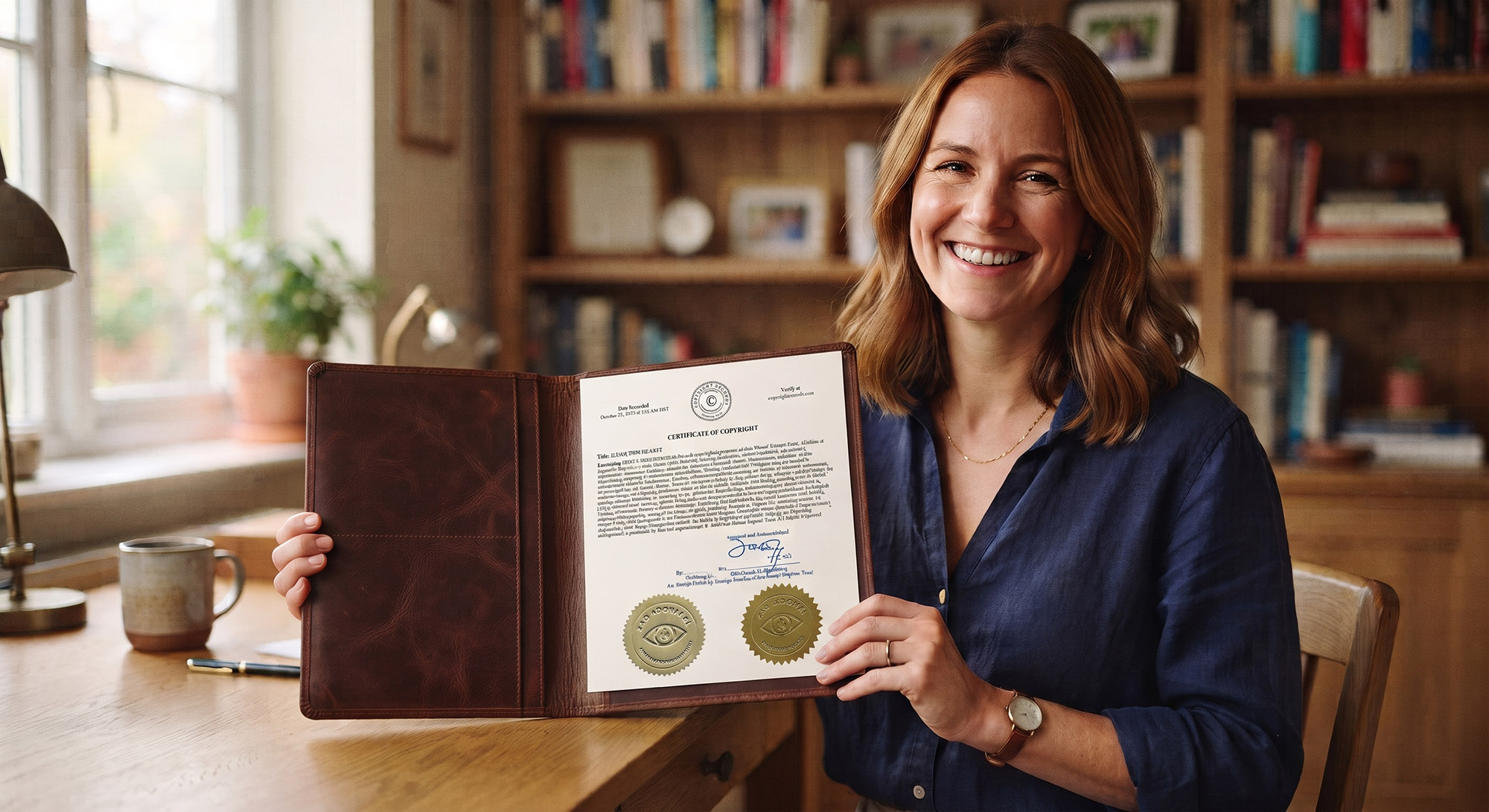
A copyright certificate from a service like ours works by creating a dated, public (or private, if you choose) record that a specific work existed, in a specific form, on a specific date — and who claims ownership of it. For example, a certificate might state:
“This book, [Title], written by [Author Name] on [date], is the sole copyrighted property of [Owner Name/Entity].”
That single record does two important jobs at once: it documents who created the work, and it documents who owns the rights to it — which matters if the work has since been assigned, licensed, or placed into a trust or business entity. If a dispute ever comes up, this becomes your evidence that your claim predates anyone else’s.
It’s worth being precise about what this certificate is and isn’t. It is not a government copyright registration, and it doesn’t replace one. What it is: strong, dated evidence of your claim — something you can rely on immediately, without paperwork or waiting periods, that can make a real difference if your work is ever stolen.
Does It Need to Be Notarized?
Not necessarily — but notarization adds something meaningful, and it’s worth understanding the difference.
A public, timestamped record on its own is already useful evidence. Courts routinely accept timestamped digital records — server logs, archived web pages, and similar records — as evidence, based on the credibility and consistency of how those records are kept. The strength of that evidence depends on the reliability of the system behind it.
Notarization adds an independent layer on top of that: a neutral third party verifying that the person signing the certificate is who they claim to be, and witnessing that they signed it on that date. That makes the document significantly more resistant to a “this was faked later” challenge, because it’s no longer just your platform’s record — it’s backed by a sworn, independent witness.
Neither version is legally required. But if you want the strongest possible evidence, a notarized certificate is the more litigation-resistant option.
A Real-World Scenario: What Happens If Your Work Gets Stolen
Here’s how this plays out in practice.
Imagine a writer — we’ll call him Luke — finishes a manuscript and gets a timestamped, notarized certificate confirming he wrote it on a specific date and assigned ownership to his trust. Months later, someone finds a leaked copy of the manuscript, publishes it on Amazon under their own name, and starts making money from it. That person even files their own copyright registration with the U.S. Copyright Office (USCO), claiming to be the author.
Here’s the part that surprises a lot of people: registering a copyright with the USCO doesn’t require the government to verify that you actually wrote the work. It’s a paperwork process. Someone can absolutely register a stolen work under their own name. That registration gives them certain procedural advantages — but it does not make them the legal owner. Ownership belongs to the true author from the moment of creation, regardless of who files paperwork first.
So what happens next? Luke’s trust has to register the work with the USCO too — this step is required before the trust can file suit in federal court, regardless of who created the work or who has better evidence. Once that’s done and the case is filed, this is where Luke’s earlier preparation pays off: his notarized certificate, dated well before the thief ever published anything, is powerful evidence that Luke — not the thief — is the true author. Combined with drafts, timestamps, and the certificate’s public record, it becomes very difficult for the thief’s later, fraudulent registration to hold up.
The Honest Trade-Off: Why Timing Still Matters
There’s one more piece worth understanding, because it changes how you should think about timing.
If a trust or author registers with the USCO after an infringement has already started, the law generally limits them to actual damages — meaning they can pursue the profits the infringer made, but not the larger statutory damages (which can run from $750 to $150,000 per work) or attorney’s fees. Those bigger remedies are only available if registration happened before the infringement began, or within three months of the work’s first publication.
In Luke’s case, this means his trust would likely still win the case and be entitled to the thief’s profits — which, if the stolen book was genuinely making money, could be substantial. But he’d likely miss out on the larger statutory damages available to creators who register early.
This is the real, practical lesson: a timestamped certificate protects your claim from day one, but it works best alongside — not instead of — early registration once a work has real commercial value. The certificate is your first line of defense and your strongest piece of evidence; USCO registration is what actually unlocks the courtroom and the strongest financial remedies.
The Bottom Line
You don’t need to wait for a legal problem to start protecting your work. A timestamped, notarized certificate:
- Costs far less than formal registration
- Takes minutes instead of months
- Creates evidence that can resolve most disputes before they ever reach a courtroom
- Becomes decisive evidence if a dispute does go to court, especially against someone who tries to falsely claim your work as their own
If your work ever grows in value, pairing that early record with formal USCO registration gives you the strongest possible protection — proof of your original claim, backed by the full legal remedies that come with registration.
Protecting your work doesn’t have to be complicated or expensive. It just has to happen before you need it.