Copyright Protection for Beaded Jewelry and Handmade Accessories: Proving Your Designs can be confusing when your work combines artistic expression, functional objects, and common materials. Beads, clasps, wire, leather, gemstones, and findings may be widely available, but the way you select, arrange, shape, and present them can reflect original creative decisions. That creativity deserves careful documentation.
For independent jewelry makers and accessory designers, the practical challenge is often not establishing that copyright exists. Copyright generally arises automatically when an original work is created and fixed in a tangible form. The harder question is proving when you created the design and that it came from you if another seller copies it, claims it first, or reproduces your marketing materials. This guide explains handmade jewelry copyright, beadwork design protection, useful evidence to preserve, and how a dated, notarized record can support your ownership claim while working alongside—not replacing—registration with the U.S. Copyright Office.
Copyright Protection for Beaded Jewelry and Handmade Accessories Begins With Original Expression
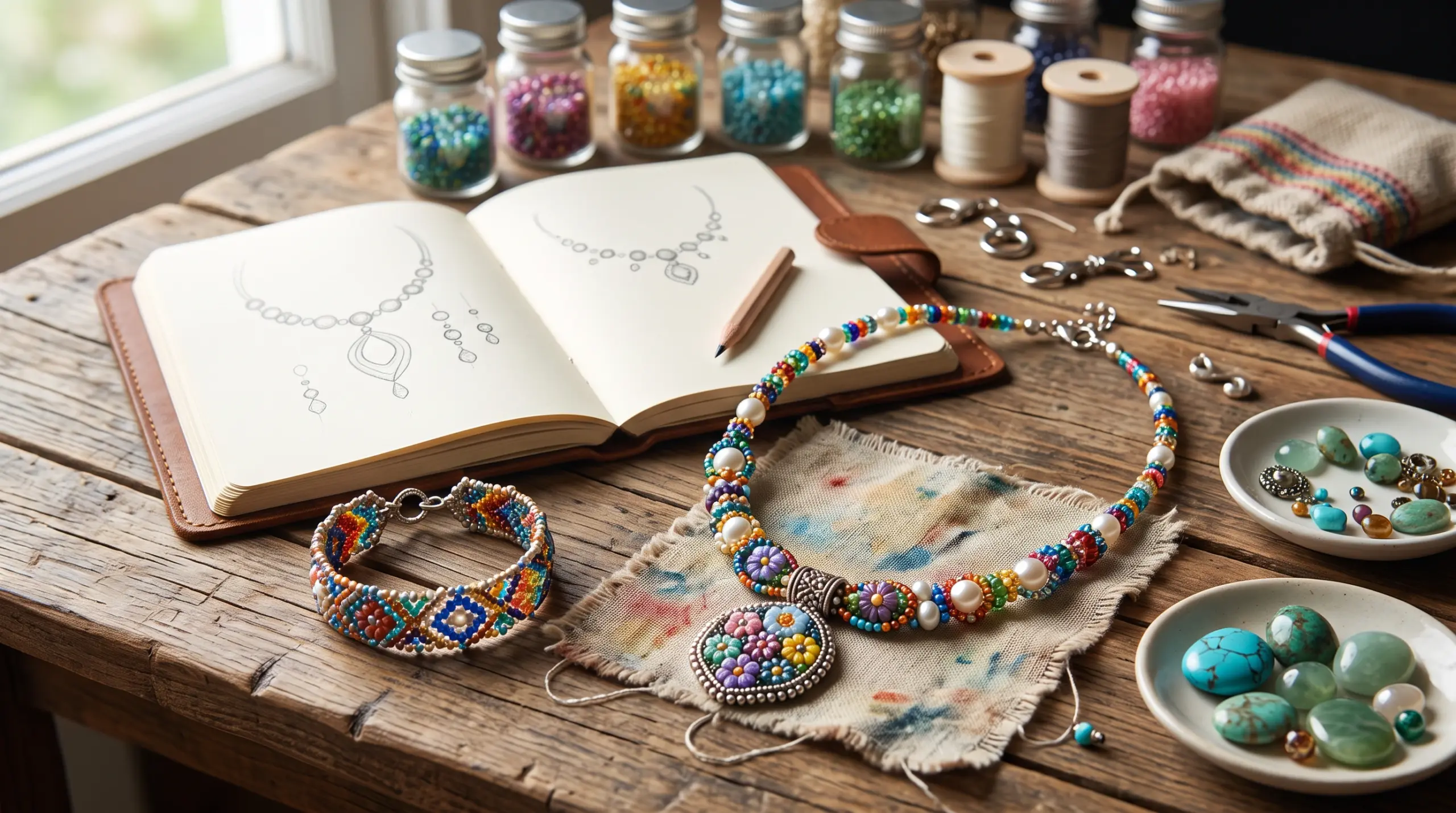
Copyright protection does not require a design to be expensive, complicated, or produced by a large brand. In the United States, an original work is generally protected once it is created and fixed in a tangible form. A sketch, pattern, product photograph, written design description, or completed accessory may all help demonstrate the creative development of a jewelry collection.
However, copyright protects original expression rather than every idea involved in making an accessory. You may be able to claim rights in an original arrangement of beads, a distinctive sculptural component, an artistic pattern, or original photographs and written descriptions. You generally cannot claim exclusive ownership over basic concepts such as “a blue-and-gold bracelet,” the idea of using a particular type of clasp, or standard techniques commonly used by artisans.
What may be protected?
Potentially protectable elements of a handmade accessory can include:
- Original sketches, diagrams, templates, and beadwork patterns.
- A sufficiently creative arrangement or composition of decorative elements.
- Original sculptural charms, pendants, figurines, or other artistic components.
- Product photography, collection images, and promotional illustrations.
- Original written descriptions, packaging artwork, and brand storytelling.
At the same time, copyright may not protect purely functional features or commonplace components by themselves. A clasp that performs a mechanical function, for example, is not automatically protected simply because you purchased or attached it. Likewise, copyright does not prevent every other maker from using similar beads or following a general jewelry-making technique.
Why the distinction matters
Understanding the boundary between an idea and its expression helps you document the strongest parts of your claim. Instead of recording only a finished product name, preserve the creative process: early sketches, layout experiments, color studies, pattern files, prototypes, and final photographs. Those materials can show that your work was independently developed and can make your artisan copyright proof more persuasive if a dispute arises.
Build Strong Evidence for Handmade Jewelry Copyright
Evidence is most useful when it is created consistently, before a conflict occurs. A social media post or online listing may help establish that an item existed by a certain date, but public posts can be edited, deleted, misdated, or challenged. A thorough documentation system gives you multiple ways to connect the finished accessory to your creative process.
Create a design record
For each significant design or collection, consider keeping a file that includes:
- The design name, creator name, and date of creation.
- Photographs of sketches, prototypes, and completed pieces.
- Digital pattern files and version histories where available.
- Notes explaining original choices of color, shape, spacing, texture, and materials.
- Receipts or inventory records showing when components were purchased.
- Dates of product photography, listings, exhibitions, and sales.
- Copies of packaging, catalog pages, and promotional content.
Do not rely exclusively on a file’s “created” date. Metadata can change when a file is copied, exported, or uploaded to another platform. Instead, preserve related records together and use consistent naming conventions. For example, a folder could contain the original sketch, prototype images, final product photographs, and a dated design statement describing the work.
Document the design before sharing it
Sharing a new piece with a customer, manufacturer, influencer, or potential retailer can create uncertainty about what was disclosed and when. Before sending files or publishing a collection, save a complete version of the design record. If you send a confidential pattern or production document, use a written agreement when appropriate and identify what may and may not be copied.
This process supports handmade accessories ownership by creating a clear timeline. It does not guarantee that every dispute will be resolved in your favor, but it gives you organized facts rather than relying on memory after months or years have passed.
How a Dated, Notarized Record Supports Beadwork Design Protection
A creator may own copyright automatically, yet still struggle to prove authorship later. That is where an independent, dated record can be valuable. Copyrightrecords.com provides a $17 copyright certificate paired with notarization through a church-based unincorporated association. The purpose is to create evidence of a creator’s claim and the existence of the documented work at a particular point in time.
The certificate can identify the creator, describe the design, and preserve supporting files or images according to the service’s process. Notarization adds an independent third party’s confirmation to the record. In practical terms, that is more substantial than simply placing files in a personal folder or mailing yourself an unverified envelope. The record is intended to be litigation-resistant evidence—not a declaration that a court must automatically accept or a substitute for legal analysis.
Why independent confirmation matters
A timestamp alone may be questioned. Someone could argue that a file was altered, backdated, or created after a dispute began. A notarized record provides additional evidence that the documentation and claim were presented for acknowledgment at a specific time. It can help establish a chronological foundation for your jewelry creator copyright claim.
Still, accuracy is essential. Submit work that you actually created, describe it honestly, and retain your original files. Do not use documentation to claim ownership of another maker’s pattern, a generic technique, or material that is merely purchased and assembled without sufficient original expression.
What this service does not do
Copyrightrecords.com is not a law firm and is not the U.S. Copyright Office. Its certificate is not official federal registration, government-backed registration, or a replacement for registration. It provides complementary evidentiary protection: a dated and witnessed record that may help prove authorship and timing if questions arise.
It also does not automatically give you the right to file a federal infringement lawsuit. Under 17 U.S.C. §411(a), and following the Supreme Court’s decision in Fourth Estate Public Benefit Corp. v. Wall-Street.com, a creator generally must have a completed registration from the U.S. Copyright Office before filing a federal copyright infringement action. Statutory damages and attorney’s fees are also affected by timely federal registration. A notarized certificate does not change these requirements.
Strengthen Your Ownership Claim With Registration and Business Records
Dated evidence and federal registration serve different purposes. A notarized certificate can help establish when you claimed and documented a design. Registration with the U.S. Copyright Office creates an official federal record and may provide important procedural and remedial advantages. For creators whose accessories are commercially valuable or frequently copied, discussing registration options with a qualified copyright attorney may be worthwhile.
Consider registering important creative assets
You may have more than one copyrightable asset connected to a jewelry business. Depending on the facts, relevant materials could include a collection of original photographs, a jewelry pattern, original packaging artwork, a catalog, or a set of designs. Registration requirements and group options can vary, so avoid assuming that one filing covers every work or every future design.
Registration should be considered especially when:
- A collection represents substantial time or investment.
- You plan to license patterns or sell wholesale.
- Your designs are widely visible online.
- You have already received a copying complaint or discovered likely infringement.
- You may need access to the remedies available under federal copyright law.
Preserve commercial proof
Business records can reinforce your creative timeline. Keep invoices, sales receipts, production notes, website backups, marketplace listings, advertising campaigns, and correspondence with retailers. Capture screenshots that show URLs and dates, but retain the original files as well.
If someone copies your work, avoid immediately deleting the evidence or making public accusations that could complicate the situation. Save the allegedly copied listing, photographs, dates, and communications. Then consider consulting a qualified attorney about whether the similarities involve protectable expression, a trademark issue, trade dress, a contract violation, or another legal theory.
Responding When Someone Copies Your Handmade Accessories
Discovering a nearly identical bracelet or copied product photograph can be upsetting, particularly when your business depends on original work. A measured response begins with evidence. Compare your dated design record with the other party’s publication date and preserve both versions in a secure location.
Ask practical questions before deciding what to do:
- Is the allegedly copied feature an original expressive element or a common technique?
- Did the other seller copy your photographs, descriptions, pattern, or finished design?
- Which version can be shown to have existed first?
- Do you have terms, licenses, or written agreements that affect use?
- Would a platform notice, negotiated resolution, or attorney letter be appropriate?
A copied photograph or product description may present a clearer issue than two accessories made from similar commercially available beads. Likewise, a distinctive original pattern may be stronger than a general color combination. These distinctions are why complete documentation is more useful than a broad statement that someone “stole the idea.”
Remember that a copyright certificate and notarized record support your evidence; they do not decide infringement. If the dispute is significant, obtain advice from a licensed attorney familiar with copyright and small-business matters. The right response may involve federal registration, a carefully drafted notice, marketplace procedures, licensing discussions, or no action at all, depending on the facts.
Conclusion: Make Your Jewelry Copyright Evidence Part of Your Workflow
Strong handmade jewelry copyright protection involves more than hoping customers recognize the original maker. Develop a repeatable workflow: save sketches and prototypes, record creation dates, preserve final photographs and descriptions, maintain business records, and document important designs before public release.
Copyright exists automatically when you create an original work. What can be difficult later is proving when you created it and that it is really yours. A Copyrightrecords.com certificate and notarization can create dated, witnessed evidence of authorship at an affordable cost. That record works alongside—not instead of—registration with the U.S. Copyright Office.
For valuable collections or serious disputes, consider federal registration and qualified legal advice. By combining organized design records, artisan copyright proof, and appropriate registration, you give your beadwork and handmade accessories a stronger evidentiary foundation as your creative business grows.