
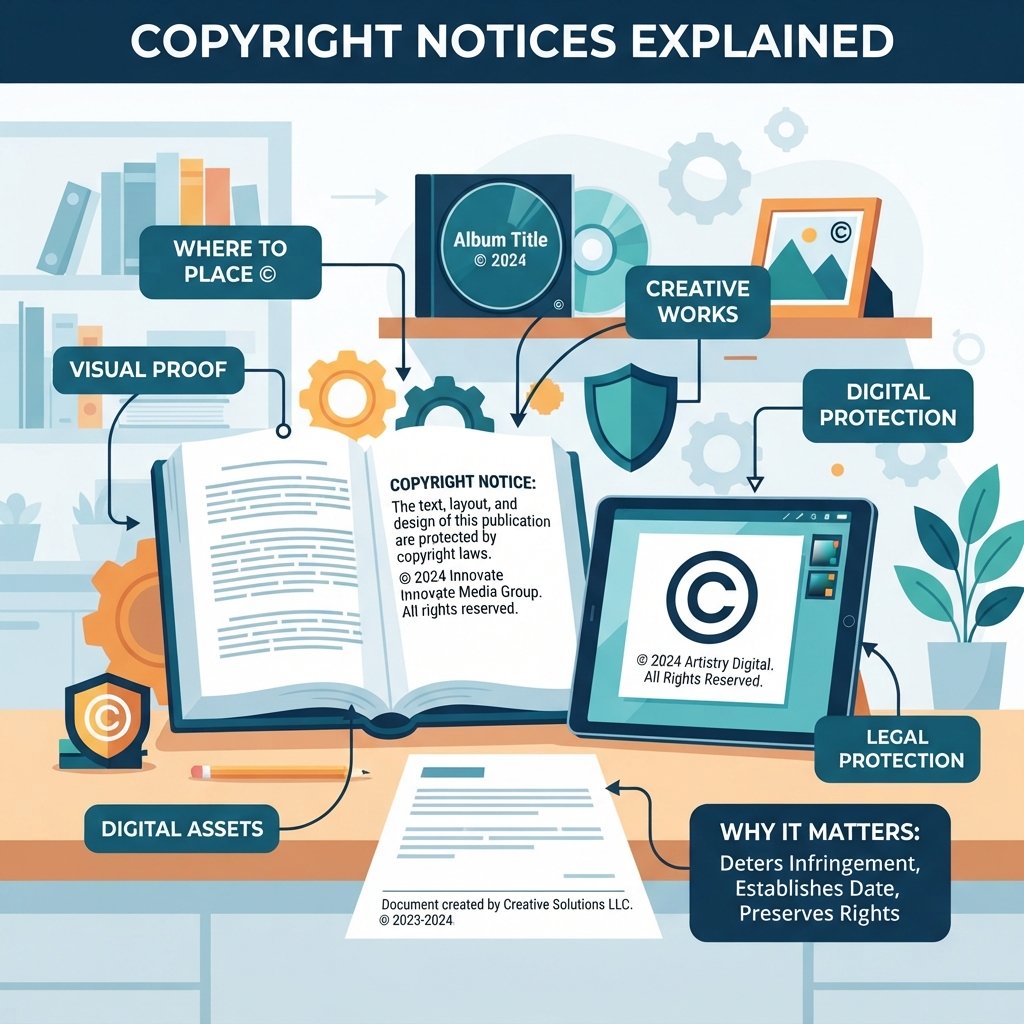
Copyright notices are small, but they answer an important question: who claims ownership of a creative work, and when was that claim made? Whether you publish a book, photograph, website, song, illustration, or business guide, placing a notice correctly can make your ownership clear to readers and potential users. However, a copyright notice does not create copyright. Copyright generally exists automatically when you create an original work, without a form, fee, or government filing. In this guide, you will learn the standard copyright notice format, where to place the © symbol, whether the copyright symbol goes before or after a title, and what a notice can—and cannot—do. You will also see why a clear notice works best when supported by a dated record of authorship and independent notarization.
Copyright Notices: What They Mean and Why They Matter
A copyright notice is a short statement identifying the copyright owner and the year the work was first published. The traditional format is:
© [year] [copyright owner]. All rights reserved.
For example:
© 2025 Jordan Lee. All rights reserved.
The notice tells the public that someone is claiming copyright in the material. It can discourage accidental copying, make it easier to identify the appropriate person to contact for permission, and weaken an argument that a user did not realize the work was protected.
Does a copyright notice create ownership?
No. Under the modern principle of automatic copyright, an original work is protected when it is created and fixed in a tangible form. You do not need to add the © symbol for copyright to exist. The notice is useful communication, not the source of the right.
Likewise, a copyright notice is not the same as registration with the U.S. Copyright Office. If you need to bring a federal infringement lawsuit, completed U.S. Copyright Office registration is generally required under 17 U.S.C. §411(a), as confirmed by Fourth Estate Public Benefit Corp. v. Wall-Street.com. Timely federal registration is also important for pursuing statutory damages and attorney’s fees. A notice does not replace that process.
Copyright Symbol Placement: Where to Put the © Symbol
The best copyright symbol placement depends on the type of work and how people encounter it. In most cases, put the notice somewhere visible but unobtrusive, where a reasonable reader or viewer would expect ownership information.
Common places for copyright notices
- Books and e-books: Place the notice on the copyright page, usually near the front of the publication.
- Websites: Put it in the footer so it appears consistently across the site.
- Photographs and artwork: Add it to a caption, credit line, metadata field, or visible watermark when appropriate.
- Music: Include it in liner notes, digital credits, album information, or the work’s documentation.
- Videos: Display it in the end credits, description, or accompanying publication information.
- Business materials: Add it to original manuals, reports, marketing content, product documentation, or downloadable resources.
For a website, a simple footer might read: © 2025 Bright Path Studio. All rights reserved. For a photograph, the notice might appear as: © 2025 Maya Chen.
Visibility matters more than decoration. A notice hidden in tiny, unreadable text may technically communicate less effectively than a plainly displayed line. At the same time, avoid covering the creative work or making the notice so large that it harms the viewer’s experience.
Copyright Notice Format and Title Placement
Understanding how to write a copyright notice is straightforward. Include three core elements:
- The copyright symbol ©, the word “Copyright,” or the abbreviation “Copr.”
- The year of first publication.
- The name of the copyright owner.
The phrase “All rights reserved” is traditional and still widely used, although it is not required to make copyright valid in the United States.
Examples of correct formats
- © 2025 Taylor Morgan
- Copyright 2025 Taylor Morgan
- © 2025 Morgan Design LLC. All rights reserved.
- © 2021–2025 Taylor Morgan for a work updated across several years
If a company owns the work, list the company’s legal name. If ownership belongs to more than one person, identify the owners clearly. For commissioned or collaborative projects, do not assume that the person who created the material is automatically the only owner. Written agreements can affect ownership and licensing rights.
Should the copyright symbol go before or after the title?
In a standard notice, the copyright symbol does not usually go directly before or after the title. It belongs in an ownership line, such as © 2025 Alex Rivera. A title may appear separately above it:
The Coastal Garden
© 2025 Alex Rivera
You may see a © symbol placed beside a title in informal settings, but that is not the clearest copyright notice format. Also remember that titles, names, and short phrases may have limited copyright protection. They may instead raise trademark or unfair competition issues, depending on how they are used.
Why a Notice Is Stronger With Dated Evidence
A copyright notice communicates your claim, but it does not independently prove when you created the work. That distinction matters if another person later publishes similar material, claims authorship, or presents a later version as the original.
A practical documentation file can include the final work, earlier drafts, source files, notes, emails, publication records, and a dated certificate identifying the work and creator. A timestamped record of authorship helps establish what existed at a particular point in time. Notarization adds an independent, sworn verification layer to the record, making the evidence more difficult to dismiss or challenge.
This kind of documentation is evidentiary protection, not official registration. Copyrightrecords.com provides a $17 copyright certificate paired with notarization for creators, businesses, and individuals who want affordable, dated, witnessed evidence. It works alongside U.S. Copyright Office registration rather than replacing it.
For example, suppose a photographer posts an image online in March and keeps a notarized record of the original file and authorship claim. Another person later downloads the image and asserts that they created it in June. The notice alone may show that the photographer claimed ownership, while the dated, notarized record can provide stronger evidence of what existed earlier. The outcome of any dispute depends on the facts, but organized evidence gives the creator a clearer foundation.
Before publishing, check that your notice identifies the correct owner, uses the appropriate year, and appears where readers can reasonably find it. Then preserve the underlying work and supporting evidence. A clear notice is a useful first step; a dated, witnessed record helps document the story behind that claim.