
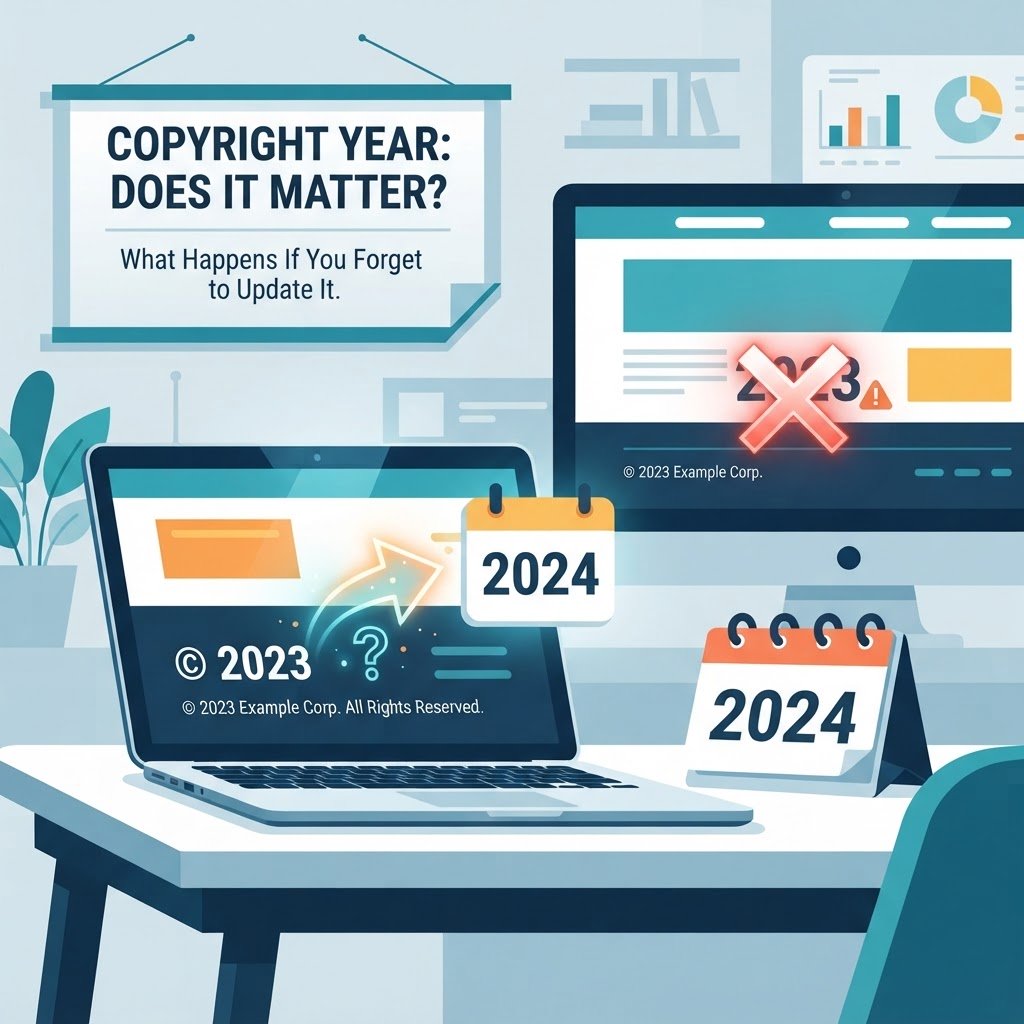
You’ve probably seen it thousands of times: that little © symbol at the bottom of a website, followed by a year—sometimes the current year, sometimes a year from five years ago. If you’ve ever owned a website, you might have wondered: does that copyright year actually matter? What happens if you forget to update it? Is it legally required? And more importantly, does it affect your actual copyright protection?
The short answer is: it’s more nuanced than you’d think. A stale copyright year won’t invalidate your copyright or make your work unprotected, but it can send the wrong message about your site and, in some cases, raise questions about your diligence as a creator or business owner. Let’s walk through what the copyright year actually does, when it matters, and what you should really be doing to protect your work.
What the Copyright Year Actually Means
The copyright year on your website footer typically indicates when you first published or created the content on that site. It’s not a legal requirement—copyright exists automatically the moment you create something, whether or not you display a year. Under the Berne Convention, your work is protected from the instant it’s fixed in a tangible medium, with or without a notice.
That said, displaying a copyright notice serves a practical purpose: it tells visitors that you claim ownership of the content and when you first asserted that claim. It’s a signal of professionalism and intent. It also protects you from an infringer’s claim of “innocent infringement”—the idea that they didn’t know the work was copyrighted. If someone can see your copyright notice, they can’t later claim they didn’t realize you owned it.
But here’s the key: the year itself doesn’t determine how long your copyright lasts. Copyright duration is tied to when the work was created, not when you update your footer. If you created something in 2015, it’s protected for your lifetime plus 70 years (for individual creators), regardless of whether your website says 2015, 2020, or 2024.
Does It Matter If You Forget to Update Your Website Copyright Year?
The Legal Side
Forgetting to update your copyright footer year won’t cause you to lose copyright protection. Your copyright doesn’t expire or weaken because your website footer is outdated. Courts understand that websites are living documents, and a stale date doesn’t invalidate your ownership claim or the protection of your work.
However, an outdated copyright year can create confusion. If your footer says © 2015 and you’re claiming you created new content in 2024, a discrepancy might raise eyebrows. It could suggest you’re not actively maintaining your site or that you’re not being truthful about when you created something—neither of which strengthens your position if a dispute ever arises.
The Practical Side
From a practical standpoint, an outdated copyright year can hurt your credibility. Visitors and potential clients notice these things. A footer that says © 2015 on a site that’s clearly been updated in 2024 makes your business look neglected or abandoned. It’s a small detail, but small details add up to an impression of professionalism—or lack thereof.
For creators and small business owners, maintaining an accurate copyright year is part of basic site maintenance, like keeping your contact information current or updating your portfolio. It takes five minutes and signals that you’re on top of your work.
What You Should Actually Do to Protect Your Work
Update Your Copyright Year Annually
Make it a habit. At the start of each year, update your website footer to reflect the current year. If you’re creating new content throughout the year, you might use a range (© 2020–2024) to show both when you started and when you last published. This is the standard approach for sites with ongoing content.
If your site is static and you rarely update it, you can use a range to cover the span of years it’s been live. For example, © 2015–2024 tells visitors the site has existed since 2015 and you’ve maintained it through 2024.
Go Beyond the Footer
A copyright notice is helpful, but it’s not the same as timestamped, notarized evidence of authorship. If you’re a creator worried about theft or plagiarism, or a small business owner concerned about protecting your original designs, logos, or content, consider creating a dated record of your work. This is where a notarized copyright certificate becomes valuable—it establishes a witnessed, timestamped record of when you created something and that it’s yours.
This kind of evidence is particularly useful if someone later claims they created your work first or if you need to prove ownership in a dispute. The copyright year on your footer is a public notice; a notarized certificate is litigation-resistant evidence.
Keep Your Metadata Accurate
Beyond the visible footer, make sure your site’s metadata is accurate too. File creation dates, image EXIF data, and document properties can all serve as supporting evidence of when you created something. These details matter less in the moment but become important if a dispute ever happens.
Real-World Example: When the Copyright Year Actually Mattered
Imagine a photographer who posted her portfolio on her website in 2018 with a © 2018 notice. She updated her site regularly but never changed the footer year. In 2023, a potential client used one of her images without permission on their website, claiming they had created it. The photographer wanted to prove the image was hers.
The outdated copyright year alone wouldn’t have been enough to prove she created it—but combined with the image’s EXIF data showing when the photo was taken, her email correspondence with clients from 2018, and the original files on her computer, she had a strong case. An updated copyright year wouldn’t have changed the outcome, but it would have made her site look more professional and maintained throughout the dispute.
Had she also created a notarized copyright certificate when she first published her portfolio, she would have had even stronger, timestamped evidence—a third-party verified record of her authorship at a specific moment in time. This kind of documentation is what really holds up if a dispute escalates.
The Bottom Line: Update It, But Know What It Does and Doesn’t Do
Your website’s copyright year should be current, but forgetting to update it won’t destroy your copyright protection. What matters more is that you’re actively creating, maintaining your work, and thinking about how to prove ownership if someone challenges it.
For independent creators and small business owners, the real protection comes from three layers: a clear copyright notice (including an up-to-date year), accurate metadata and file records, and—for work you truly want to protect—a notarized record of authorship that serves as litigation-resistant evidence.
Start by updating that footer this week. Then, if you’re creating original work regularly, consider taking the next step: creating a timestamped, notarized record of your authorship. That combination gives you the credibility and evidence you need if a dispute ever happens.